World | Jan 20, 2026
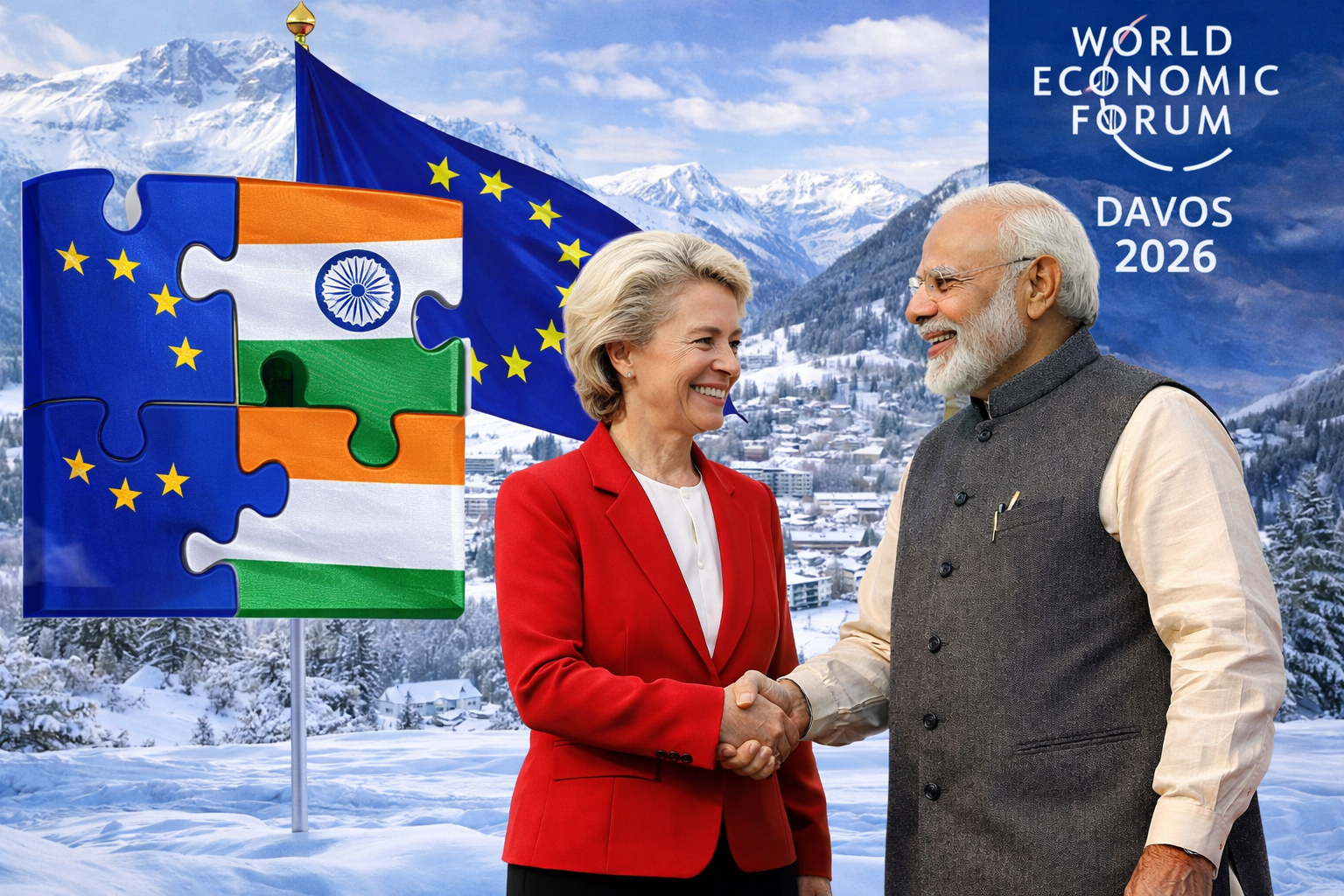
India and the European Union are on the verge of sealing a long-awaited Free Trade Agreement (FTA), with European Commission President Ursula von der Leyen signalling that a breakthrough could come as early as next week. Speaking on the sidelines of the World Economic Forum (WEF) in Davos 2026, von der Leyen described the proposed pact as the “mother of all deals”, underscoring its scale and strategic significance.
According to the EU chief, negotiations between New Delhi and Brussels have entered their final and most decisive phase after years of complex and often stalled talks. The agreement, once concluded, is expected to comprehensively cover trade in goods and services, investment flows, intellectual property, sustainability standards and regulatory cooperation between India and the 27-member European Union.
“The talks are extremely advanced. We are at the cusp of something very big,” von der Leyen said, hinting that political momentum on both sides has aligned to push the deal across the finish line.
Officials familiar with the negotiations said the FTA would mark one of the most ambitious trade agreements ever entered into by India, opening up vast market access for Indian exporters while providing European companies deeper entry into one of the world’s fastest-growing major economies. Key sectors under discussion include automobiles, pharmaceuticals, textiles, renewable energy, digital services and manufacturing.
For the European Union, the agreement is seen as a strategic move to diversify supply chains and strengthen economic ties with a trusted partner amid global trade uncertainties and geopolitical tensions. For India, the pact would enhance access to the EU’s high-value market, boost exports, attract investment and reinforce its position as a central player in global trade.
Negotiations on the India–EU FTA were first launched in 2007 but faced repeated delays due to differences over tariffs, market access, labour standards and environmental norms. Talks were formally revived in recent years, with both sides adopting a more pragmatic and phased approach.
If concluded, the agreement would not only redefine India–EU economic relations but also send a strong signal in favour of open, rules-based trade at a time of growing protectionism worldwide. As von der Leyen’s remarks suggest, the long-running negotiations may finally be nearing their historic conclusion.